




Introduction
- Opening statement with statistics: The risk associated with manually reviewing contracts will amount to $10 million in 2026; automation can reduce this risk by 70%.
- The article highlights how automation is revolutionizing risk detection and clause extraction through artificial intelligence and machine learning.
- Perfect for legal professionals, contract managers, and business executives seeking increased efficiency.
Understanding Risk Detection and Clause Analysis
- Clause Extraction Definition: AI analyzes contracts to identify important clauses such as liabilities, SLAs, and penalties.
- Risk Detection Definition: Detecting non-compliance, uncertainties, or high-risk clauses such as indemnity or termination clauses.
- Comparing Manual and Automated Processes: The manual approach misses 30% of risks, while automation achieves 95% accuracy using NLP.
The Impact of Automation on Risk Analysis
Technologies Powering Automation
- Parsing Legal Language with NLP and LLMs: To Identify Risks in Real-Time.
- Machine Learning Models: Can Learn via Feedback Loops to Improve Over Time.
Major Advantages of Automation
- Time-Savings: Reviews within Minutes, not Days, Cut by 80%.
- Precision: Understands 1,200+ Data Fields Without Errors.
- Fees Saved: Fewer Legal Battles and Compliance Fines.
Step-by-Step Clause Extraction Workflow
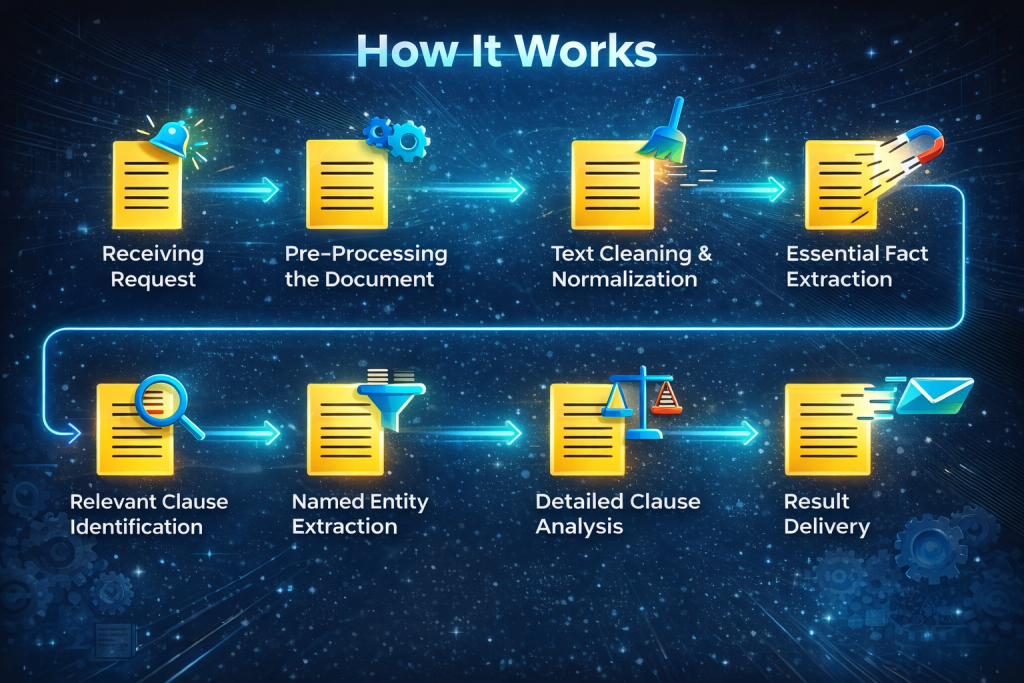
How Clause Extraction Works
Read also : IEM vs AirPods: Which Offers Better Sound Quality?
- Introduction
- Understanding Risk Detection and Clause Analysis
- The Impact of Automation on Risk Analysis
- Technologies Powering Automation
- Major Advantages of Automation
- Step-by-Step Clause Extraction Workflow
- How Clause Extraction Works
- Practical Applications
- Leading AI Tools for Contract Analysis in 2026
- Benefits and Limitations of Automation
- Emerging Trends in Contract Automation
- FAQ
- Final Thoughts
- Contracts uploaded on the AI-powered platform.
- AI extracts and categorizes different clauses (such as change-of-control or non-compete).
- Data mining and structuring for dashboard reporting.
- Manual intervention only on edge cases to improve machine learning.
- Software allows continuous updates to keep track of obligations.
Practical Applications
- Due Diligence in Law: To Identify Risks in Many Contracts at Once.
- Compliance Management: For Proactive Renewals and Expiration Dates.
- Procurement: To Identify Risky Terms Before Signing.
Leading AI Tools for Contract Analysis in 2026
| Tool | Key Features | Strengths | Best For |
| Sirion | 1,200+ fields, LLMs, real-time tracking | High accuracy, integrations | Enterprise CLM |
| Ironclad | Clause classification, playbook automation | Workflow speed | Mid-market |
| DocuSign | NLP extraction, risk insights | Ease of use | SMBs |
| Icertis | ML explainability, compliance | Complex contracts | Global deals |
Benefits and Limitations of Automation
- Advantages: Preemptive risk management, improved transparency, data-backed decision-making.
- Disadvantages: Set-up expenses, data integrity requirements, dealing with existing contracts.
- Crossing obstacles: Start with pilot projects, train teams, select scalable platforms.
Emerging Trends in Contract Automation
- AI-based generation of clauses and simulations.
- Incorporating blockchain technology for risk recordkeeping.
- Predictive analytics for identifying future contract disputes.
FAQ
- What is clause extraction through artificial intelligence?
AI employs natural language processing to extract and organize certain clauses from contracts for analysis and monitoring at a speed impossible with manual processes.
- How does automation help detect risks?
It identifies concealed risks such as non-compliance instantly, reducing review time by 80% while increasing precision to 95%.
- Which tools will be the best for clause extraction in 2026?
According to Gartner, Sirion, Ironclad, DocuSign, and Icertis top the list, with LLM-driven extraction and risk analysis features.
- Is automation capable of dealing with complicated legal language?
Certainly, LLMs and machine learning algorithms interpret ambiguities with human intervention ensuring 99% accuracy for exceptional cases.
- What advantages can automation provide in contract management?
Speedy reviews, reduced expenses, compliance, and centralized reporting for informed decision-making.
More Read

- Automation security for critical contracts?
Best software includes encryption and secure storage, ensuring GDPR/CCPA compliance.
- How can you implement automation for risk detection?
Select your software, integrate into process flow, educate your team, and track KPIs such as review time.
- What are the gaps in automation?
Few edge cases; however, feedback processes reduce them greatly—always do human checks.
Final Thoughts
- Automation is revolutionizing risk management and clauses extraction through creating strategic contracts rather than liabilities.
- Important lessons: Automation accelerates efficiency and accuracy, best software is Sirion, and being proactive saves money.
- Are you ready for automation? Check out Sirion or Ironclad free trials now For more tech guides, subscribe to newsy.in