



When users of the Internet search for a term such as a top 10 biggest country in the world, they are typically curious to know about the countries that occupy the greatest territories. It is an easy question, which is the starting point of entry into the exploration of great landscapes, different cultures, and the geo-political importance of these giant countries. OK, the first question I always want to ask, and the question that you can immediately answer is what are the ten largest countries in the world based on total land area? The answer of course is Russia, Canada, China, the United States, Brazil, Australia, India, Argentina, Kazakhstan and Algeria.
Here is the updated list of the top 10 biggest countries in the world by area in 2025:
| Rank | Country | Area (km²) | Region |
|---|---|---|---|
| 1 | Russia | 17,098,242 | Northern Asia, Europe |
| 2 | Canada | 9,984,670 | North America |
| 3 | China | 9,706,961 | Eastern Asia |
| 4 | United States | 9,372,610 | North America |
| 5 | Brazil | 8,515,767 | South America |
| 6 | Australia | 7,692,024 | Australia |
| 7 | India | 3,287,590 | South Asia |
| 8 | Argentina | 2,780,400 | South America |
| 9 | Kazakhstan | 2,724,900 | Central Asia |
| 10 | Algeria | 2,381,741 | North Africa |
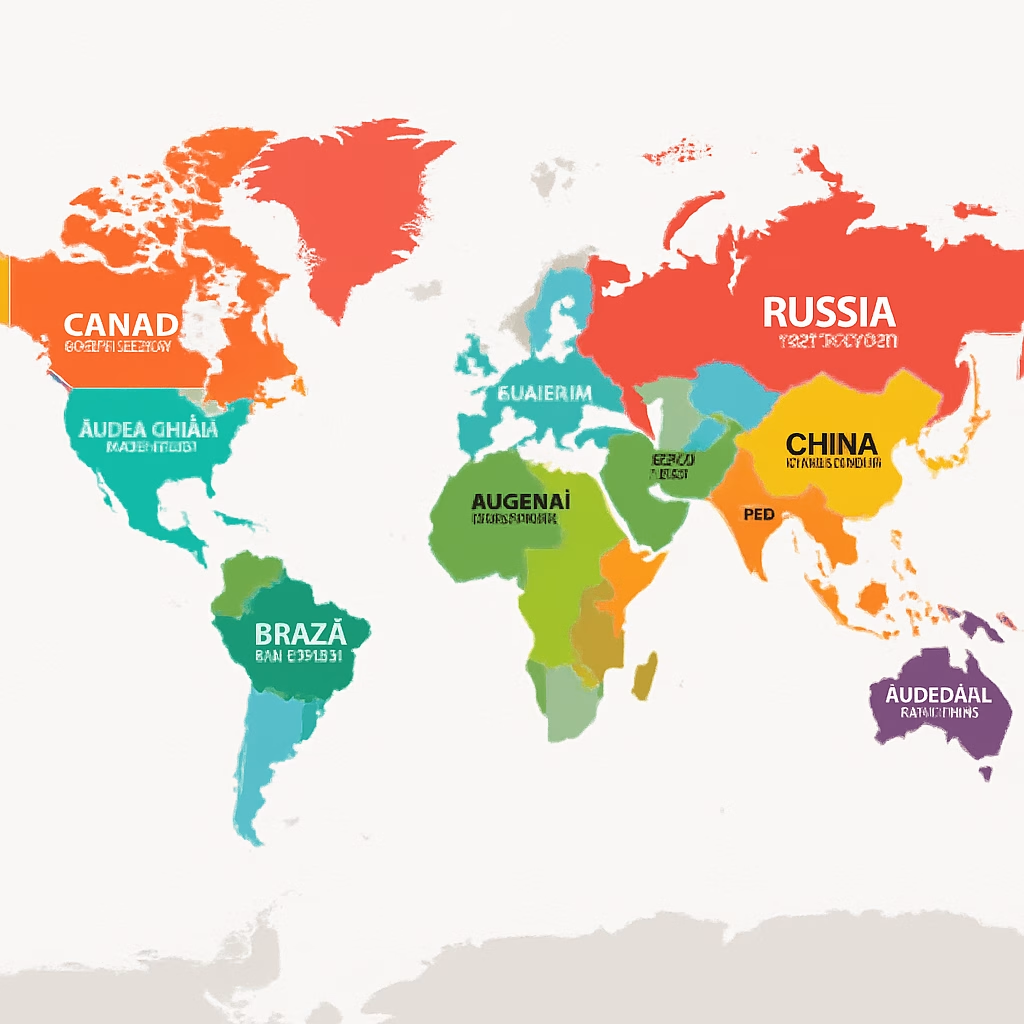
1. Russia
Russia is the largest country in the world but it is divided into two continents namely Europe and Asia. It encompasses approximately 11 percent of the totalcorrectedingerlE shocknew wake volunteers and landmass of the globe. This immense area gives Russia a very large variety of environments, from the Arctic tundra in the northern part to forests and mountain ranges in the southern region. Its capital city, Moscow, is a vibrant city with a great deal of history and culture. The size of Russia places it as a geographical giant, and also a substantial participant in world politics, energy and military strength.
2. Canada
Canada is the second largest and the largest one in the Western hemisphere. Canada is the favorite of nature lovers, thanks to its awe-inspiring outdoor beauty that comprises huge forests, lakes, and mountains among other natural features. The bulk of its population are mainly distributed along the US border with cities in question: Toronto, Vancouver and the capital, Ottawa covering energetic urban living. Due to the large area of Canada there are varying climatic zones, ranging between arctic to temperate rainforest.
3. China
China takes the third position, with its contrasts, huge deserts, lush river valleys and mountain plateaus. It has the biggest population in the world and this makes it have huge economic and cultural power. Beijing, as the capital, is the center of ancient historical development and modern development. The country is simply too large to house homogeneity and embraces an exigent variety of ethnicities, languages, and foods.
4. The United States
The United States is the fourth-largest country and it consists of diverse landscapes in the southwest (deserts), northeast (forests), the Great Plains, as well as tundra (in Alaska). The country is diverse in terms of its citizens, and it ranks among the countries in the world leading in technology, entertainment, and finances. Washington D.C is the political centre of the country.
5. Brazil
Brazil is the largest nation in South America that is recognized globally due to the Amazon rainforest, the largest tropical forest in the world that plays an important role in the ecosystem of the earth. The culture of Brazil is colorful with the contributions of natives, Portuguese settlers and African heritage. Its metropolitan areas are busy, such as the cities of São Paulo and Rio de Janeiro, but are matched by vast natural settings.
6. Australia
Australia is a unique nation since it is a country as well as a continent. It is home to desert outback, tropical rainforests and famous animals such as kangaroos and koalas and has immense open spaces as well as modern cities like Sydney and Melbourne. Australia has a comparatively small population despite its enormous size and much of the population resides along the southeast coastline.
7.India
India ranks seventh and only second in the world with regard to size and population respectively. It is the land of fantastic cultural, linguistic, religious diversity. India has a diverse landscape, beginning with the Himalayas in the north to the waters of the tropical south. It hosts pre-historic societies and contemporary economic development and therefore is highly influential in the world.
8. Argentina
The land is diverse with a temperate Pampas grassland and cold glaciers of Patagonia in the south of Argentina. It is a vibrant country with its locally developed culture coupled with the ample European heritage. Its capital is Buenos Aires and is famous because of tango music, food and art.
9. Kazakhstan
Kazakhstan is a republic of Central Asia characterized by endless steppes and deserts. Although it was formerly part of the Soviet Union, now it is the independent and resource-rich country. Nur-Sultan (previously Astana) is the capital with an outlook of modern development and architecture demonstrating business ambitions on the international arena.
10. Algeria
Algeria, which is the largest landmass in the Africa region, is overshadowed by the Sahara Desert. Although the country has an arid climate, it is rich in history which was shaped by Berber, Arab and French cultures. The capital, Algiers, rests on the Mediterranean coast, contrasting the place of the past with the contemporary urbanist environments.
Knowing the Influence of These Big Countries
All these top 10 countries impact the global politics, economics, environment and culture significantly due to their size, which determines the natural resources available and their carrying capacity in terms of population size, as well as the strategic significance. Having a concept of such magnitudes puts perspective to a lot of what happens in the world and what humans face in nature.
This holistic and humanistic account can tell that answer to the question of the top 10 biggest countries in the world. With accurate information and backgrounds, this book offers a value addition to readers who seek to know facts and insight about these world titans. The text is designed in a presentable format to match with searcher intent and it is optimized on the keyword top 10 biggest countries in the world.
The biggest countries are ranked based on their total land area, which includes all land within their international boundaries, excluding bodies of water like lakes and rivers.
Russia is the biggest country in the world, covering about 17.1 million square kilometers, making up roughly 11% of the Earth’s total landmass.
Not necessarily. While China and India are among the biggest countries by area and have the highest populations, some large countries like Canada and Australia have relatively small populations compared to their size.
The United States is the fourth largest country by land area, following Russia, Canada, and China, with approximately 9.37 million square kilometers.
Typically, the rankings include sovereign countries and their total land area, but exclude dependent territories unless specifically mentioned.