


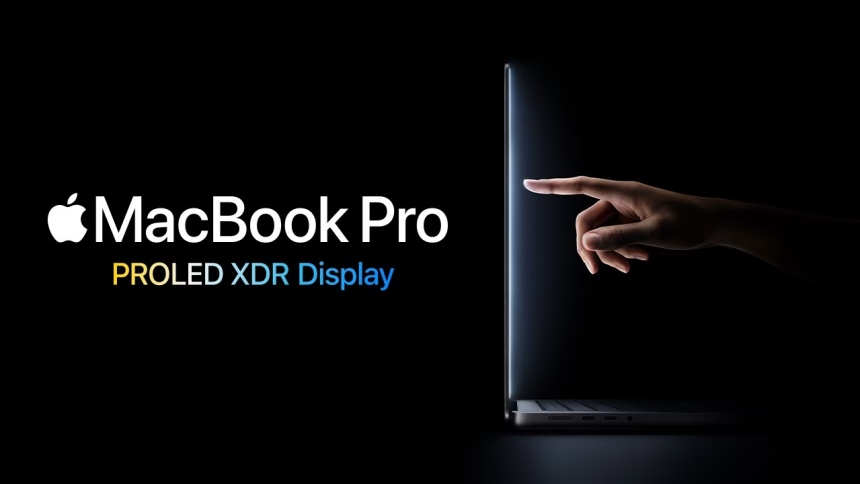
Apple has introduced the new MacBook Pro with a PROLED XDR display, bringing tandem OLED technology and touchscreen controls to its professional laptop lineup. Announced on October 28, 2026, the new models combine a redesigned display with M5 Pro and M5 Max chips, a lighter body and additional features for creative professionals.
The new PROLED XDR display is the biggest talking point. Apple claims it delivers peak brightness of up to 2,000 nits, a 10,000,000:1 contrast ratio and support for both P3 and Adobe RGB colour spaces. The display also supports adaptive refresh rates of up to 120Hz.
The new MacBook Pro is available in 14-inch and 16-inch configurations. In India, prices start at ₹3,49,900 for the 14-inch M5 Pro model. Pre-orders opened on October 28, with availability scheduled to begin on November 9, 2026, according to Apple’s announcement.
What Is the MacBook Pro PROLED XDR Display?
PROLED XDR is Apple’s new display technology for the MacBook Pro. It uses a tandem OLED panel designed to deliver high brightness, deep blacks, accurate colours and strong contrast in a portable professional display.
Unlike a traditional LCD panel, which uses a backlight to illuminate pixels, OLED pixels generate their own light. This allows individual pixels to turn off when displaying black, helping produce deeper blacks and more precise contrast.
Apple’s tandem OLED design uses multiple OLED layers to improve brightness and display performance. The company also uses display-engine algorithms and factory calibration to maintain consistent brightness, grayscale and colour reproduction.
More Read

These improvements could be especially useful for photographers, video editors, colourists, graphic designers and other professionals who rely on accurate visual output.
MacBook Pro PROLED XDR Display: Key Specifications
| Feature | PROLED XDR MacBook Pro |
|---|---|
| Display technology | Tandem OLED |
| Display sizes | 14.2-inch and 16.3-inch |
| Peak HDR brightness | Up to 2,000 nits |
| Peak SDR brightness | Up to 2,000 nits |
| Contrast ratio | 10,000,000:1 |
| Refresh rate | Adaptive 10Hz–120Hz |
| Colour spaces | P3 and Adobe RGB |
| Touchscreen | Yes |
| Processors | Apple M5 Pro and M5 Max |
| Maximum unified memory | Up to 128GB |
| Maximum storage | Up to 16TB |
| Battery life | Up to 24 hours |
Specifications are based on Apple’s published announcement. Actual performance and battery life can vary with configuration, applications and usage.
PROLED XDR vs Liquid Retina XDR: What’s the Difference?
Apple previously used Liquid Retina XDR displays with mini-LED backlighting in the MacBook Pro. The new PROLED XDR display switches to tandem OLED technology and adds touchscreen support.
Here are the main differences.
| Feature | Liquid Retina XDR | PROLED XDR |
|---|---|---|
| Display technology | Mini-LED LCD | Tandem OLED |
| Peak HDR brightness | Up to 1,600 nits | Up to 2,000 nits |
| Peak SDR brightness | Up to 1,000 nits | Up to 2,000 nits |
| Contrast ratio | 1,000,000:1 | 10,000,000:1 |
| Touch support | No | Yes |
| Colour spaces | P3 | P3 and Adobe RGB |
| Maximum refresh rate | 120Hz | 120Hz |
The main difference is how the displays produce light. Liquid Retina XDR uses a system of mini-LED backlights, while PROLED XDR uses self-emissive OLED pixels.
This gives PROLED XDR an advantage in black levels and advertised contrast. Its higher peak brightness may also improve the visibility of HDR highlights and content in bright environments.
Support for Adobe RGB is another important addition for photographers and designers who work with colour-managed images and print-oriented workflows.
However, specifications alone do not establish which display is more accurate in every situation. Real-world performance also depends on calibration, colour management, content and viewing conditions.
Why Is Tandem OLED Important?
Tandem OLED technology stacks multiple light-emitting OLED layers instead of relying on a single emitting layer.
This arrangement can help a display achieve higher brightness while managing the demands placed on individual layers. It can also support improved display efficiency and longevity, depending on the panel design and operating conditions.
Apple says its PROLED XDR display combines this panel technology with real-time pixel control and compensation techniques. These systems are designed to maintain brightness uniformity and grayscale accuracy as the display is used over time.
For professionals, this matters because a bright screen is only one part of a good reference display. Consistent colour reproduction, predictable brightness and accurate shadows are also essential when editing photographs, grading video or preparing designs for publication.
Apple’s specifications are promising, but independent testing will be needed to establish how the new display performs across different professional workloads.
MacBook Pro Now Supports Touchscreen Controls
The new MacBook Pro introduces touchscreen support to the MacBook Pro lineup for the first time.
Users can scroll through webpages, zoom into photographs, move objects between presentation slides and interact directly with supported creative applications. Apple says the touch sensor is integrated into the display panel rather than added as a separate layer.
The keyboard and trackpad remain available, so touchscreen controls complement rather than replace the traditional Mac workflow.
This feature could be particularly useful for designers working with visual layouts, musicians using software instruments and 3D artists manipulating models. Its practical value will depend on how well individual applications use the new interaction methods.
MacBook Pro PROLED XDR Price in India
Apple’s announced starting prices in India are listed below.
| Model | Starting price |
|---|---|
| 14-inch MacBook Pro with M5 Pro | ₹3,49,900 |
| 16-inch MacBook Pro with M5 Pro | ₹4,09,900 |
| 14-inch MacBook Pro with M5 Max | ₹5,49,900 |
| 16-inch MacBook Pro with M5 Max | ₹5,89,900 |
These are announced starting prices. Final prices can change depending on the selected configuration, available offers and retailer.
Apple opened pre-orders on October 28, 2026. The company’s announcement lists November 9, 2026, as the start of customer deliveries and availability in stores.
Buyers should check Apple’s official India store for current availability, configuration options and applicable offers.
Who Should Consider the New MacBook Pro?
The PROLED XDR MacBook Pro is aimed primarily at people who need a powerful laptop and a high-quality built-in display.
Video editors and filmmakers: The high advertised brightness, contrast and wide colour gamut may help with HDR editing and colour grading.
Photographers: Adobe RGB support could be valuable for colour-managed workflows, particularly when preparing images for print.
Graphic designers: A touchscreen and wider colour support offer additional ways to interact with visual content.
Software developers: The M5 Pro and M5 Max configurations, high memory capacity and touchscreen features may suit demanding development workflows.
Existing MacBook Pro owners: The display, touch controls and lighter design may be compelling upgrades, especially for people who work extensively with visual content.
For general browsing, office work and everyday computing, the existing Liquid Retina XDR models may still be more than sufficient. Buyers should consider the price difference and their actual workload before choosing the newer display.
Should You Upgrade to PROLED XDR?
The new display is a significant hardware change, but not every user needs it.
If you regularly edit HDR video, work with colour-sensitive images or want touchscreen interaction on a MacBook Pro, PROLED XDR offers several features worth considering.
If your current MacBook Pro already handles your work comfortably, upgrading solely for the display may not provide enough value. The M5 Pro and M5 Max chips are also available in the existing mini-LED lineup, so buyers should compare configurations carefully rather than assume the new display automatically means faster processing.
Independent reviews, colour-accuracy measurements, sustained-brightness tests and long-term battery assessments will help establish the real-world advantages of the new models.
Frequently Asked Questions
What is PROLED XDR on the MacBook Pro?
PROLED XDR is Apple’s new tandem OLED display technology for the MacBook Pro. It offers up to 2,000 nits of peak HDR and SDR brightness, a 10,000,000:1 contrast ratio and support for P3 and Adobe RGB colour spaces.
Is the MacBook Pro PROLED XDR a touchscreen?
Yes. The new models support touch gestures, including scrolling, pinch-to-zoom and direct interaction with supported creative applications. The keyboard and trackpad remain available.
What is the MacBook Pro PROLED XDR price in India?
The announced starting price is ₹3,49,900 for the 14-inch M5 Pro model. The 16-inch M5 Pro starts at ₹4,09,900, while M5 Max configurations start at ₹5,49,900 and ₹5,89,900 for the 14-inch and 16-inch models, respectively.
How is PROLED XDR different from Liquid Retina XDR?
PROLED XDR uses tandem OLED technology, while Liquid Retina XDR uses a mini-LED LCD system. The newer display offers higher advertised peak brightness, a higher contrast ratio, touchscreen support and Adobe RGB colour-space support.
When will the new MacBook Pro be available in India?
Apple announced pre-orders beginning October 28, 2026, with availability scheduled to start on November 9, 2026.
Is PROLED XDR better for video editing?
Its high brightness, contrast and wider colour support could benefit HDR video editing and colour grading. However, independent measurements are needed to assess colour accuracy, sustained brightness and performance in professional workflows.
Final Verdict
The MacBook Pro PROLED XDR introduces tandem OLED technology, touchscreen controls and improved advertised display specifications to Apple’s professional laptop range. Its combination of high brightness, deep contrast and P3 and Adobe RGB support makes it particularly interesting for photographers, video editors and designers.
The starting price of ₹3,49,900 places it firmly in the premium laptop category. For professionals who can benefit from its display and touch capabilities, it may be worth considering. Other users should compare it with the existing Liquid Retina XDR MacBook Pro before spending more.
As independent testing becomes available, buyers will have a clearer picture of how much the new display improves everyday creative work.