
If you’re searching what is the difference between mass and weight, the answer is simple:
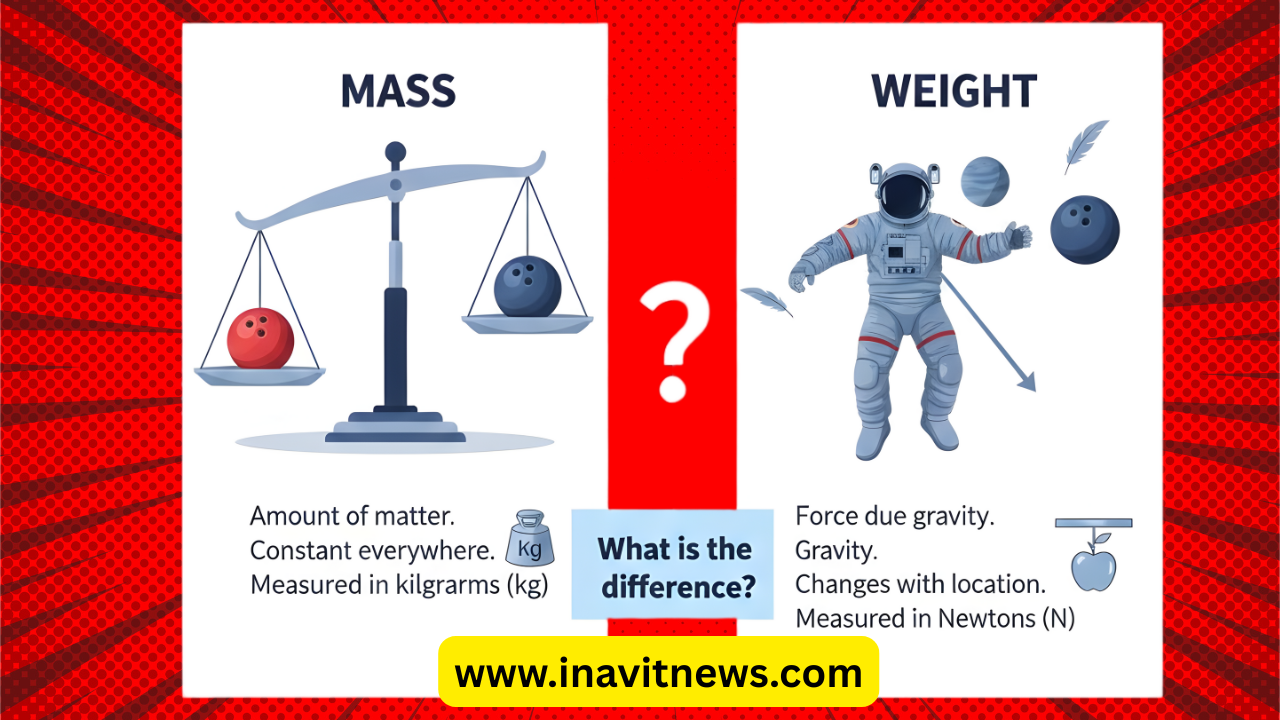
- Mass is the amount of matter in an object.
- Weight is the force gravity applies to that mass.
Many students mix them up, and honestly, I did too back in school. A physics lab experiment finally made it click—my mass stayed the same everywhere, but my weight changed every time we simulated different gravitational forces. That simple demo transformed how I understood basic physics.
So in this guide, you’ll get clear definitions, formulas, differences, examples, and reasons why we mix up the two concepts.
Let’s break it down clearly and practically.
🧩 Mass vs Weight: Definitions
Mass is the total amount of matter in an object. It never changes, no matter where the object is located.
- Unit: kilograms (kg)
- Measures: matter
- Constant: yes
- Device used: balance
Mass is fundamental—it doesn’t care whether you’re on Earth, Mars, or floating in space.
Example
A 10 kg dumbbell on Earth is still 10 kg on the Moon. The dumbbell’s mass doesn’t change.
Weight
Weight is the force of gravity pulling on an object’s mass.
- Unit: newtons (N)
- Formula:
Weight = Mass × Gravitational Acceleration - Changes with location: yes
- Device used: spring scale
Example
On Earth:
10 kg × 9.8 m/s² ≈ 98 N
On the Moon:
10 kg × 1.6 m/s² ≈ 16 N
Same mass, wildly different weight.
🔍 What Are the Difference Between Mass and Weight?
Here’s a simple comparison that students love:
| Feature | Mass | Weight |
|---|---|---|
| What it measures | Matter | Gravitational force |
| Unit | kg | Newton (N) |
| Changes with gravity? | No | Yes |
| Instrument | Balance | Spring scale |
| Type | Scalar | Vector (has direction) |
| Constant everywhere? | Yes | No |
This table alone can answer most exam questions on what are the difference between mass and weight, but let’s dig deeper.
🌍 Real-Life Examples You’ll Recognize
1. Astronauts in space
Astronauts appear weightless because gravity is extremely weak.
But their mass stays the same—that’s why they still need the same amount of force to move their bodies.
2. Grocery store scale
A balance scale compares mass, not weight.
That’s why we use kilograms (kg), not newtons.
3. Elevators
When an elevator accelerates upward or downward, your weight changes momentarily, but your mass remains constant.
📘 Why People Confuse Mass and Weight
You’re not alone—students confuse these concepts because:
- In everyday life, we say “I weigh 60 kg,” even though kg is mass, not weight
- Gravitational acceleration on Earth is almost constant, so weight seems constant
- Most consumer scales measure weight but convert it into mass automatically
Schools rarely explain why this conversion happens, which creates lifelong confusion.
📚 Scientific Insight (with Approximate Data)
A NASA guideline explains that gravitational acceleration varies dramatically between planets:
- Earth: 9.8 m/s²
- Moon: 1.6 m/s²
- Mars: ~3.7 m/s²
- Jupiter: ~24.8 m/s²
This means your weight can vary by more than 10×, but your mass remains unchanged. This statistic alone demonstrates why learning what is the difference between mass and weight matters in real science and engineering.
🧪 How to Calculate Weight (Easy Formula)
Formula:
Weight (W) = Mass (m) × Gravity (g)
Example Problem
A robot has a mass of 50 kg.
- On Earth:
W = 50 × 9.8 = 490 N - On Mars:
W = 50 × 3.7 = 185 N
Same mass, different weights.
This matters in robotics, aerospace, and even engineering—if the weight changes, materials must be redesigned for safety.
🧠 Developer Insight (Applied Example)
When designing physics simulations or game engines (Unity/Unreal), developers separate:
- mass → affects inertia, movement, collisions
- weight → affects gravity-related force calculations
I once debugged a simulation where a character floated unnaturally. The issue?
Mass was set correctly, but gravity wasn’t applied as force, so weight didn’t exist in the simulation. Once weight was implemented correctly, the system behaved realistically.
Understanding mass vs weight is essential for accurate physics modeling.
📝 Best Practices for Remembering the Difference
- Mass = “Matter” (both start with M)
- Weight = “Wow gravity pulls me down!”
- Mass stays the same
- Weight changes everywhere
- If units are in kg, you’re talking mass
- If units are in N, you’re talking weight
🔗 Helpful Resources
- NASA – Gravity Basics (authoritative science resource)
- Wikipedia – Mass
- Wikipedia – Weight
- Physics Classroom (student-friendly learning)
❓ FAQ for What Is the Difference Between Mass and Weight?
Because mass measures matter, while weight measures the force of gravity acting on that matter.
Yes. Weight is measured in newtons because it’s force: mass × gravitational acceleration.
No. Mass stays the same everywhere. Only weight changes.
It’s a language shortcut. Scales convert weight (force) into mass, so we see kg instead of N.
Yes—if an object is in free fall or far from any gravitational source. But mass can never be zero.
🎯 Conclusion
Understanding what is the difference between mass and weight helps you perform better in exams, understand physics in daily life, and even build better simulations if you’re a developer. While mass stays constant, weight changes based on gravitational forces. Once you grasp this, physics becomes far more intuitive.